Showing posts with label settlement. Show all posts

Monday, December 5, 2016

Carcassonne

France
Settlement
Carcassonne
Since the pre-Roman period, a fortified settlement has existed on the hill where Carcassonne now stands. In its present form it is an outstanding example of a medieval fortified town, with its massive defences encircling the castle and the surrounding buildings, its streets and its fine Gothic cathedral. Carcassonne is also of exceptional importance because of the lengthy restoration campaign undertaken by Viollet-le-Duc, one of the founders of the modern science of conservation.


Medieval Carcassonne is a fortified town rather than a castle - and perhaps the most impressive fortified medieval town to be found. Which is ironic, because in the middle of the 19th century it was in such bad repair that it became scheduled for demolition, to be saved by the efforts of the local mayor, who called in the new 'historic monuments' department to take a look. The city was saved, the well known architect Eugene Viollet-le-Duc took the renovation project in hand, and the rest, as they say, is history. Due to its position on historical routes across France the location has been occupied for more than 5,000 years, and was an important centre from 2,500 years ago onwards. It was first fortified by the Romans, and given the name Carcaso. 

Later, as we enter the 13th century, the Albigensian Crusade under Simon de Montfort attacked and seized this cathar stronghold, and again more fortifications were added, sufficient to keep Edward the Black Prince out of Carcassonne during the Hundred Years War.Subsequently the location and town gained strategic importance from being on the frontier between France and Spain. This became less important after 1659 when the Treaty of the Pyrenees passed the town and region definitively to France - hence from the 17th century onwards the need for a defended city passed and Carcassonne became an important regional town.Carcassonne reached its low point at the middle of the 19th century, when a century of abandon had made it perilously dangerous and the government demanded it be demolished. The buildings within the city were inhabited but in very poor condition. The efforts of the mayor and the ancient monuments inspector had this decision overturned and the restoration of the town began shortly afterwards.


Eridu

 Mesopotamia
 City


Eridu
Eridu  was considered the first city in the world by the ancient Sumerians and, certainly, is among the most ancient of ruins. Founded in circa 5400 BCE, Eridu was thought to have been created by the gods and was home to the great water god Enki. The Sumerian King List cites Eridu as the “city of the first kings”, stating, “After the kingship descended from heaven, the kingship was in Eridu” and the city was looked back upon by the variouis tribes and city-states of Mesopotamia as a metropolis of a 'golden age’ in the same way the writers of the biblical narratives created a 'Garden of Eden’ as their mythical paradise from which humanity fell.

The city was an important center for trade as well as religion and, at its height, was a great 'melting pot’ of cultures and diversity, as evidenced in the various forms of artistry found among the ruins. Eridu was abandoned intermittently over the years for reasons which remain unclear and, finally, left behind completely sometime around the year 600 BCE. 


Around 2050 BCE there was a precipitous decline of the Eridu’s wealth. This was likely caused by further recession of the gulf coast and an increasingly unreliable water table. This ecological change led to the temple ziggurat of Amar-sin being left uncompleted. However the remains of the ziggurat and the 17 stages of development layered beneath it provide a valuable insight into the significance of this location.

The original building was a small square room with a pedestal outside of which was a kiln or oven. Upon this site increasingly complex temples were built, many showing signs of burned offerings and the remains of fish which were thought to be sacred to Enki. For 3,500 years this site would be the focus of Eridu and then the city would crumble to ruin leaving only the temple. Enki’s temple was honored and restored well after the city was otherwise uninhabited in a tradition the lasted until the 6th century BCE.


Monday, October 17, 2016

Halicarnassus

Bodrum, Mugla Province, Turkey
Settlement

Halicarnassus

Halicarnassus an ancient Greek city of Caria, situated on the Gulf of Cerameicus.  Herodotus, a Halicarnassian, relates that in early times the city participated in the Dorian festival of Apollo at Triopion, but its literature and culture appear thoroughly Ionic. The city, with its large sheltered harbour and key position on the sea routes, became the capital of the small despotate, the most famous ruler of which was a woman, Artemisia, who served under Xerxes in the invasion of Greece in 480 bc. Under Mausolus, when it was the capital of Caria (c. 370 bc), it received a great wall circuit, public buildings, and a secret dockyard and canal, while its population was swollen by the enforced transference of the neighbouring Lelegians. On the death of Mausolus in 353/352, a monumental tomb, the Mausoleum, considered one of the Seven Wonders of the World, was built by his widow in the city.
The Mausoleum of Halicarnassus was built for Mausolus, the second ruler of Caria from the Hecatomnid dynasty (and nominally a Persian satrap) who died in 353 BC. As the man who refounded Halicarnassus, Mausolus was entitled to receive cultic honours and a tomb on the central square of his city, in accordance with Greek custom. The person in charge of this project was Mausolus’ grieving widow, Artemisia II, who, incidentally, was also his sister.
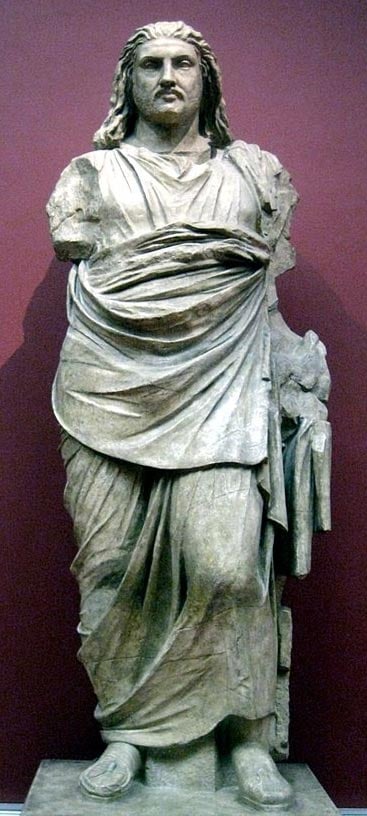
Statue of Mausolus at the British Museum, 2012.
By the end of the Peloponnesian War (in any case after 412), Halicarnassus had lost its independence and was part of the Persian Empire again. It belonged to the satrapy of Caria, which was ruled by a local dynast called Hecatomnus of Mylasa 

The site, extensively excavated in 1856–57 and 1865, retains much of its great wall, remnants of the gymnasium, a late colonnade, a temple platform, and rock-cut tombs. The ancient remains are somewhat overshadowed by the spectacular pile of the castle of the Knights of St. John, founded about ad 1400.