Showing posts with label Austin Young. Show all posts

Monday, December 12, 2016

Monastery of St. Giorgio Maggiore


                        Monastery of St. Giorgio Maggiore


 Venice has so much to offer and traveling around the city is so much fun on gondolas or water taxis. One destination for those who are interested in architecture and history is the 16th century Monastery known as San Giorgio. The Church is located on the island of St Marks Basin in Venice, Italy.The High Renaissance Monastery was designed by Andrea Palladio in 1566. The architect lived on the island for 20 years before starting the construction in 1565. Some elements still had to be finished after his death in 1580, including the white marble facade which was finished in 1611. 
Palladio fashioned his design in the Neoclassical tradition.


One can rent a modest room in the monastery with the the best views for an affordable rate. Known ass one of the architectural glories of Venice, most tourists only get fought up in the maze of Venice see this beautiful monist art from a distance. But like all of Venice there is amazement and history behind every corner.


San Giorgio is one of the world’s longest continually operating Benedictine abbey


Sources
http://www.reidsitaly.com/destinations/veneto/venice/sights/san_giorgio.html#campanile
http://www.venice-tourism.com/en/luoghi/dorsoduro-district/island-san-giorgio-maggiore

Monday, December 5, 2016

Santo Spirito, Florence


                                    Santo Spirito, Florence


The Santo Spirito is an Augustinian monk built Church. Constructed in 1252 renaissance architecture.Designed By  Filippo Brunelleschi, his design is a complex geometry on the inside the simple facade tells a lie on the outside of whats to come.


[ o O ]


Facade of Santo Spirito

Brunelleschi’s blend of architecture comes alive when entering the church. The interior is
complemented with hypnotically geometry with rhythmic in columns, squares and circles, 
Brunelleschi’s has an obsession with order, geometry, and symmetry that form this beautiful
church .  Proportions nothing but perfect bringing everything together masterfully. 
The dark Pietra Serena Highlights the dark edges to contrast the light stucco creating a 
very soothing pallet.


Sources
http://www.yourwaytoflorence.com/db/chiese/spirito.htmhttp://florenceforfree.co/2013/11/07/the-basilica-of-santo-spirito/

Zecca, Venice Italy


                                                           Palazzo della Zecca

Venice, Italy has a long  history of minting that dates back to the Roman times. In the  the 16th century the government had a need for a new mint building and so the Palazzo della Zecca was created becoming the official government mint Located in Venice Italy. It was specifically built to be fire resistant excluding the use of wood. It was a strategically placed facing the Sea, so there was no hazards sparks from molted metal. The facade has a strong feeling of power and strength with the columns that leaves it feeling more like a fortress then a coin mint. 

The designed by Jacopo Sansovino. After he won a 
competition for the commission. There was a need for a new mint after a financial boom in the 1530’s. The building was designed in Rustic Dorick style of Architecture to reclaim the prestige of the Roman legacy. To achieve this the architects intent was to build a building that displayed the fortitude of the economy of Venice. He achieved this by placing heavy lintels and ring half columns around the windows. Originally the building was only going to have two floors but the architect wanted the building to look more formidable from the sea. 


The formidable building withstood the hands of time and produced coins for 330 years. Finally, when Venice became a part of Kingdom of Italy in 1866 the mint closed. The building today holds the "Saint Marks Library" with prestige and fortitude giving a second life to this iconic building.


Sources

htthttp://www.venicethefuture.com/schede/uk/135?aliusid=135p://arth335001.blogspot.com/2010/04/jacopo-sansovino-zecca-mint-venice-1535.html
Zecca : the mint of Venice in the Middle Ages Author: Alan M Stahl

     
Libreria di San Marco, walled-up window of the Zecca in the southwest corner of the piano nobile (photograph by author)


Jacopo Sansovino and assistants, main doorway, Zecca, 1554––56 (photograph by Ralph Lieberman)


Zecca and Libreria di San Marco, schematic plan as of 1556 (drawing by David Mihm)

Tower of London


The Tower of London


When I think of the Tower of London I think of a medieval prison for kings, a lonely circular tower top with stone floors and a straw bed, with iron bars in place of a door.  Alas I am revealing my ghastly American side.   The White Tower structurally is a keep, and one of the oldest of its kind therefore a UNESCO World Heritage Site. The tower was also whitewashed by Henry the III.  I will write about whitewashing, not the whitewashing that happens when white actors are chosen to play ethnic roles such as Asian or Indian, but   whitewashing the décor by painting everything white.


  In Manhattan you will hear the synonymous term “French Country” whispered by decorators to give an impression of something sophisticated and elite.  To explain my relationship with whitewashing you have to understand a little bit about my childhood, my father is a master cabinetmaker, specializing in French cabinetry.  I can still smell the ebony dark woods, and feel the texture of the aged hard woods as I ran my small fingers down the raw beams.  To me the materials of a structure are like the ingredients for a chef, to be celebrated, appreciated, and the center point of an experience.  For myself, I find painting white over an exposed brick wall, an aged oak door frame, a mid century cherry cabinet, the same as pouring a container of salt on top of a meal at a 5 star restaurant. 


The Tower of London was built with Caen stone from France, Kentish Ragstone, Portland Stone, and Mudstone.  Beautiful ingredients that I would never paint white over.  As an architectural student, I appreciate the patina of materials within the structure, the worn out corroded bolts on a steal door, the discoloration of subway tile mosaics from the one train on the IRT line, the foggy glare of an antique mirror made from silver, the oxidized copper roof ornament, the splintering beams supporting a stucco ceiling or the weight of a quarter ton door dragging along creating a crease on its floor trajectory in an factory loft.  Please don’t add a can of white paint to sterilize the space in an effort to be sheik.  White is clean like a hospital, and is an easy technique to makeover a space, what is hard, is to preserve the soul of a structure while adding your signature touch.          

Sources
http://www.hrp.org.uk/tower-of-london/visit-us/top-things-to-see-and-do/white-tower/#gs.12UJ2as
http://www.bing.com/images/search?q=+white+washs+walls+toer+of+london&view=detailv2&&id=49121F2392E10CAAA4AB7996C6454A0D4A51C2AB&selectedIndex=22&ccid=IUodleKu&simid=607986487834707820&thid=OIP.M214a1d95e2ae8f2ebe4b88a6d1e7a52fo0&ajaxhist=0

Friday, December 2, 2016

Church of St. Mary Redcliffe


                               Church of St. Mary Redcliffe

          Queen Elizabeth described it as the "Fairest, goodliest, and most famous church in England"

ST. Mary Redcliffe is a beautiful example of Gothic Architecture located Bristol, England. Built between 12th and 15th century, I imagine this church was a labor of love for the Cristian faith. Build and and decorated by wealthy merchants who's tombs now and monuments are placed all around the church.

Rich with history there is there is a ship modle and a whale bone brought back from  John Cabot's 1497's voyage to the new world. A room is dedicated to the poet Thomas Chatterton where he wrote some of his "Rowley Poems" in his short  life dying at just the age of 17. There is also a tomb of Admiral Sir William Penn. notable for his sons land acqusition in the new world of the state of Pensilvania.


Today this church is a very active with fresh progressive Ideas church opening its doors the website physical and mental health and ability, and in our understanding of gender and expression of sexuality identity.
In addition The church created a community project called the Arc cafe is an (ARA) Addicts Recovery Agency which provides a wide range of education, training and employment opportunities at the church. In these days of people losing faith its refreshing to see a thriving progressive church and you can see why it has lasted for over 900 years.


Photo by: Adam Rumble
The Beautiful Nave Ceiling 


Stain glass  dedicated 17th century composer Fredrick Handle 


Sources 
http://www.sacred-destinations.com/england/bristol-st-mary-redcliffe
http://www.britainexpress.com/attractions.htm?attraction=3718

Wednesday, November 16, 2016

“Megalith”


                                                                Megalith


      From the great pyramids of Giza to the contemporary work Levitating Mass, by California artist Michael Heizer, artists have chosen large stones as their medium for self-expression. Megalithic structures have captured the imagination and minds of archeologists, historians and artists. The term megalith, from the Greek word for "great stone" is a large stone or stones that are moved by mankind to build a monument or structure.  The stones are often assembled by the craftsman without the use of mortar. Instead the massive stones are often interlocked together to create the megalithic structure. One cannot observe such a structure without asking key questions such as, why ancient artisans chose to build the enormous monuments and what they were used for. What is even more perplexing is how these massively heavy stones were moved by civilizations that had limited resources and technology. 


In his work, Levitated Mass, (2002) Micheal Heizer attempts to evoke the enormity and ingenuity of ancient craftsmen and the meaning behind the megalithic structural form. Using today's technology and resources, the 340 ton granite megalith took 11 nights to move 340 miles from a quarry to its installation at the Los Angeles County Museum of Modern Art. The public who can move around and underneath the structure must wonder how feats such as Heizer's could possibly be achieved by ancient man.
In his film, "levitating Mass", film maker Doug Pray shows great numbers of people coming out of their homes to watch the stone being moved. As I watched the viewers in awe of the Herculean effort of the moving crew I felt as if they were participants in an ancient religion honoring such a massive stone. Could this be modern art as a spiritual institution?, I wondered. 
Pray's documentary gives insight into the mysteries of ancient megalithic structures. It helped to explain how and why structures such as, The Stone of the South, circa 970 BC was moved and erected. The Stone of the South weighs an estimated 1242 tons and is the largest megalith ever worked by man. It was raised 20 feet in the air and was made to fit with precision with other stones around it. 

Refrences
Documentary
Levitated Mass, (2002) Micheal Heizer
Book

The seventy wonders of the ancient world By Chris Scarre

Tuesday, November 15, 2016

"Dome of the Rock"


                                The Dome of the Rock


“Holy is He Who carried His servant by night from the Holy Mosque (in Makka) to the farther Mosque (in Jerusalem) – whose surroundings We have blessed – that We might show him some of Our signs 1. Indeed He alone is All-Hearing, All-Seeing.” (Quran 17:1)


This religious verse from a holy book might not seem relevant or important to us in the west, but for over a billion Muslims this parable gives Muslims the divine right over Jerusalem.   As it is believed by all Muslims the Dome of the Rock (Qubbat As-Sakhrah) was the destination of Mohammed’s (PBUH) night journey. To commemorate this religious milestone, the Dome of the Rock was the first Islamic structure to be built using the dome design, the dome design that is now ubiquitous with modern day mosques worldwide. 


Originally constructed in the 7th century, the Islamic shrine has been continuously remodeled and been overtaken ever since.  As an architect, some buildings are not just the sum of bricks and mortar but they are much more, a spiritual connection, a political statement, and even a sacred religious symbol.  So as an architectural student what do I take from this, well it is going to sound cliché: location, location, location.  If just the structure of the Dome of the Rock was in Egypt it would be a minor tourist attraction, well eclipsed by the Pyramids of Giza.   However the Dome of the Rock is in Israel and after the six day war it suddenly became the third holiest place in Islam behind the Kaaba in Makah and the Grand Mosque in Medina. 


A structure that laid abandoned and barely noticed became a symbol that people were willing to die for or even more importantly kill for.  So why is the Dome so important, why am I writing about it now, because of its location.  When you are faced with a building project, ask yourself not just about the budget, the specifications, but also take into account the location.  Location can make a building insignificant or all important.


Sources
1.     Isra and Miraj the Miraculous night Journey
2.     Home Page
3.     Encyclopedia Britannica

http://www.sacred-destinations.com/israel/jerusalem-dome-of-the-rock/photos/dome-of-the-rock-exterior-detail-c-torie
https://quadralectics.wordpress.com/3-contemplation/3-3-churches-and-tetradic-architecture/3-3-1-the-form-of-the-ground-plan/3-3-1-4-the-octagonal-church-plan/

"Pont Du Gard"


                                     Pont Du Gard 


Pont Du Gard is a Roman aqueduct and bridge, located in France that has stood the test of time. considered a work of art it is a truly masterful example of roman architecture and engineering.  the structure has three tiers of arches and stands 49 meters high over the river of Gard. it carried an estimated (44,000,000 imp gal) daily at an astonishingly precise gradation. It supplied fountains, baths and homes in the city of Nimes.

http://www.pontdugard.fr/en/espace-culturel/cinema


The aqueduct is close to two thousand year old, one of the main reasons it has survived for this long is because it was used as a toll bridge and maintained over the decades. It is thought that it took around fifteen years to construct by upwards of a thousand workers. Today to cross the Pont du Gard it would cost you 18 Euro. There is a documentary cinema on the site as well as a museum showing the history of the roman aqueduct.

 Beyond the Pont Du Gard site there is a small village called Vers-Pont-Du-Gard that you can actually see how a roman aqueduct interacting with three lavors (wash houses). The village on the northern eastern end a very long ruined section of the Pont Du Gard. you can also see the some Roman quarries from where the stone that built the aqueduct are from.


references

www.pontdugard.fr/en/ancient-work-ahttp://
www.kuriositas.com/2010/10/pond-du-gard-aqueduct-bridge.htmlrt

"Basilica San Clemente"


                                  Basilica San Clemente


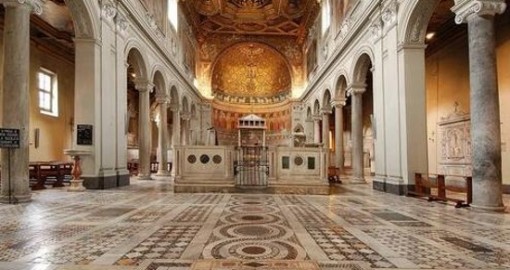
 San Clemente built in 1100 AD is a beautiful however unremarkable basilica located in Rome.  When I say that please don’t take that personally, but Rome and Europe for that matter have so many architectural wonders that it wouldn’t be considered even in the top 100 must see sights.  What brings the tourist packing in to this relic, is also the reason why I am writing about it today.  San Clemente was built on top of a fourth century church, and before that a 2000 year old pagan temple.  I wish I had come up with this, but in the spirit of Italy, it is warmly referred to as architectural “Lasagna,” because of its layers of history.  It is a curiosity that as human beings we flock to the to the San Clemente Basilica not to admire the well kept church on top, but to dwell in its dark cavern like structure underneath.


  This dark place where your guide has to point out the stone couch used during pagan feasts (the cult of Mitharas)  is pretty much the selfi highlight of the tour.  In fact a quick reference to Instagram as a social barometer, will confirm that the original church on top is of very little interest to the masses.  What is the significance for architects, specifically what can my fellow architects in training learn from this.  If you come across an existing structure, don’t be afraid to incorporate it into your new design.  Don’t let your ego, tell you that you need a clean slate to achieve your artistic integrity.  Leave room for the past in your new designs/renovations, maybe it is something simple like a vintage telephone switch board, a horse stall, a coal chimney, a dumb waiter, or an old stone well in the basement. These might be the real treasures you have failed to notice.      

basilica-di-san-clemente-basilica-di-san-clemente-in-rome-stay-71377


Sources

New York Times Magazine Online

Basilica San Clemente Website

Instagram

Monday, October 31, 2016

"African Burial Ground Memorial"


                                African Burial Ground Memorial


The African Burial Ground Memorial is located Downtown Manhattan  in the financial district. Originally unearthed in 1991 during excavating for a new federal building. brought light to the fact that NYC from the colonial days had a long history of slavery. At first a dozen of remains found some twelve feet underground by construction workers. Most of the remains were men under the age of thirty. Later excavating the area all in total over 419 sets were found. An estimated fifteen thousand African Americans were buried on the grounds.


Memorial Designed by Rodney Leon

Most Americans like myself have the presumption that slavery was a Southern phenomenon that the northeast was free state. But in fact at some point there were more slaves in New York State then Georgia. Even a public slave market at the east end of Wall Street opened up 1711 it wasn’t until the mid 1800-century were African Americans even considered free men.

A few Google searches in and you can see the horror that these people faced. Laws restricting slaves to participate in any form of society. 

The architect designed a well thought out memorial to commemorate the site and teach the sacrifice the African Americans made to build New York City. His concept was a space that reflected a ritualistic ideas through libation and ceremony.


References
http://www.bbc.co.uk/history/british/empire_seapower/slave_island_01.shtml