Showing posts with label England. Show all posts

Monday, December 5, 2016

Hereford Cathedral

HEREFORD CATHEDRAL


The Hereford Cathedral depicts one of the earliest building that acts as a center of worshiping. The building is in the city of Hereford located in the west midlands of England. Hereford Cathedral is mainly a dedication to the two saints; Saint Ethelbert the King who was beheaded in the 792 and the saint holy Mary the Virgin. The building further depicts of representation of architectural works dating in the 11th century (Lehmberg 2014). The building employs the traditional building aspects employed by many architects especially those with origin from the United Kingdom.
The building material used in building the Hereford Cathedral mainly was the fire stone masonry. The fire stone masonry usually requires great engineering skills and a constant supply chain of material to form stable and long lasting building. The use of the stated material in constructing the Hereford Cathedral could be the idea behind the main reason to why the building remains strong, stable and attractive.
Unlike other buildings that had a specific architecture, the Hereford Cathedral followed a series of bishops who mandated the role of constructing the building. The building further underwent a series of collapsing and had to rebuilt over and over again. Bishop Robert of Lorraine could be the main personnel who initiated the project followed by the Bishop Reynelm, and Robert de Betun, who triggered the building to completion (Lehmberg 2014).
The Description of interior of the building
                                    
Image by www.mapio.net


                                                                                              Bishop Reynelm initiated the project of building the interior part of the building.
 The Bishop incorporated the Norman architectural design of interior walls and adopting columns and arches that resemble the Norman style. At the northern entrance of the building, there is a porch with Decorated doorway. Besides, the doorway leading to the Lady Chapel comprises of a modern lantern with rood screen. The Lady Chapel employs the lancet windows, and a groined roof (Lehmberg 2014).
Besides, the building incorporates the gothic style in decorating most of the walls of the buildings. The gothic style distinguishes itself on the outlook especially on the South Transept; the transept comprises of five layers of arches designed with the stated style. The south transept further comprises of medieval brasses that still are in good condition. Indicating the high level of expertise involved in the design and construction of the building the Hereford Cathedral (Lehmberg 2014). Moreover, the Hereford Cathedral houses the tombs of these Bishops who played a great role in constructing the building.


Work Cited:
            Lehmberg, S. E. (2014). The Reformation of Cathedrals: Cathedrals in English Society. Princeton University Press.
@infed. "What Is Community Work?" Infed.org. N.p., 04 Nov. 2016. Web. 04 Dec. 2016.


Durham Castle/Cathedral, England, UK, 11th Century


Durham Castle was built in the late 11th and early 12th centuries to house the relics of St. Cuthbert. Durham Castle is also known as the Durham Cathedral, or the Durham Monastery. This monastic cathedral was built to house monks that follow the Benedictine Order.
Durham Castle
The Durham Castle was founded by William the Conqueror, after his victory at the Battle of Hastings. This castle was residence to many Prince-Bishops, in which each bishop had a goal to make their marks in the castle by inserting many additions and different embellishments. The castle had been heavily damaged as a result of the English Civil War. The Lord Mayor of London had bought this castle after, but had no intention of restoring the damaged castle. It was not until after the restoration of the monastery did the bishops finally move back to the castle to begin its renovation.

View of Durham Castle
The Castle and Cathedral are located on a peninsula in the River Wear. The purpose of these structures were for those in the community of St. Cuthbert to serve as a protective hiding place from the vikings.

The Durham Castle is considered the most perfect monument of the “Norman” architecture style. The Durham Castle actually belongs to Durham University now. They are connected, and today is used as learning spaces and experiences for students.


Works Cited:
"Sacred Destinations." Durham Castle - Durham, England. N.p., n.d. Web. 05 Dec. 2016.


Centre, UNESCO World Heritage. "Durham Castle and Cathedral." UNESCO World Heritage Centre. N.p., n.d. Web. 05 Dec. 2016.

Canterbury Cathedral

England
Cathedral
Canterbury Cathedral
Canterbury Cathedral is one of the oldest Christian churches in England and it continues to play a central role in English Christianity. Originally founded in 602 AD by St. Augustine, it still functions as the cathedral of the Archbishop of Canterbury, the leader of the worldwide Anglican Communion. Canterbury was an important spiritual center ever since Augustine, but it became a major pilgrimage destination after the martyrdom of St. Thomas Becket in 1170.

The grandeur of the architecture reflects Canterbury's historic and religious importance, as does the magnificent collection of medieval stained glass windows depicting miracles experienced at Thomas' shrine, biblical scenes, prophets and saints. A monastery was also established in connection with the cathedral. Around 750 AD, A baptistery-mausoleum was added to the north of the church, but none of this survives.


 In 1011, Canterbury was among the many English towns devastated by marauding Danes, who traveled up the rivers killing and pillaging from their longships. The city was destroyed, the cathedral was set on fire, and Archbishop Alphege was taken hostage in hopes of ransom. Alphege reportedly refused to allow anyone to pay for him, and was pelted to death with oxbones at the Danish camp in Greenwich. The archbishops story is told in a medieval stained glass window in the cathedral.

In 1093, a man named Anselm became Archbishop of Canterbury. Most notably, Anselm built the huge and beautifully decorated crypt beneath the east end, which still survives fully intact. An extensive choir with ambulatory, consecrated in 1130, was then built over the crypt.Critical to the history of Canterbury Cathedral was the murder of St. Thomas Becket on Tuesday, December 29, 1170, by order of King Henry II. The king later performed penance there in 1174. On September 5 of that same year, the great Romanesque choir was devastated by a fire.
During World War II, the cathedral's beautiful stained glass windows were removed for safekeeping from Hitler's air raids. It was a wise decision - the replacement windows were blown in. A large area of the town of Canterbury was destroyed, as was the cathedral library, but the main body of the cathedral remained intact. You can still visit Canterbury Cathedral today, it is one of the worlds most visited places.


Sunday, December 4, 2016

Westminster Abbey- London, England, 10th Century

Image: Google Maps
Located in the heart of London, on the banks of the river Thames, West Minster Abbey may be one of the most well-known churches in England. The royal wedding of Prince William and Kate Middleton may have been the most recent, global event there but coronations and royal weddings have been held in the church since 1066, the coronation of William the conqueror. Not only is the church used for these momentous occasions, it is also used regularly, for the tradition of daily worship which began in the middle of the tenth century. Westminster Abbey is also home to the tombs and memorials for some of the most significant people in England’s history. The site celebrates the great events in the life of the nation.

George IV Coronation in 1821
Image: www.westminster-abbey.org. 

Every monarch since William the Conqueror has been crowned in the Abbey. The two exceptions to this since 1066 are Edward V and Edward VIII who were never crowned. The shrine of Edward the Confessor is behind the High Altar and around it, many medieval royal members are buried. Included in these are Henry III, Edward I and Eleanor of Castile, Edward III and Philippa of Hainault, Richard II and Anne of Bohemia and Henry V. In addition to housing the remains of the kings and queens of the past, the Abbey also contains many national treasures. The abbey contains over 600 monuments and wall tablets, a treasure house of paintings, stained glass, pavements, textiles and other artifacts.

In the middle of the 10th century, Benedictine monks first came to the site. In the 1040s, Kind Edward chose to enlarge the monastery, building a large stone church in honour of St Peter the Apostle. This church became  known as the “west minster” to distinguish it from the east minster, St Pauls Cathedral in London. Today, the only traces of this time are in the round arches and massive supporting columns of the undercroft and the Pyx Chamber. Edward’s Abbey survived until the middle of the thirteenth century when King Henry III rebuilt the church.

Image: www.westminster-abbey.org
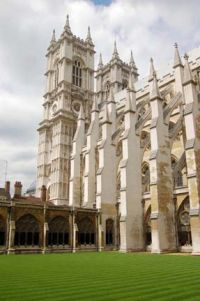
Henry’s devotion to St Edward the Confessor prompted him to build a newer, more magnificent church in the Gothic style. He also provided a shrine for the Saint with space where he can be buried himself. The three masons supervising the work were Henry of Reyns, John of Gloucester and Robert of Beverley. The architect was clearly influenced by the newer cathedrals at the time, borrowing ideas of an apse with radiating chapels and using the gothic features of pointed arches, ribbed vaulting, rose windows and flying buttresses. The design is based on a system of geometrical proportions. The English influences are the single , rather than double, aisles. And a long nave with wide, projecting transepts. The Abbey has the highest Gothic vault in England at nearly 102 feet. The English influences are also apparent in the elaborate mouldings on the main arches, the lavish use of polished Purbeck marble for the columns and the overall sculptural decoration.

Henry VII's Lady Chapel
Image: www.westminster-abbey.org
Consecrated in 1516, the glorious Lady Chapel was a new addition to the Abbey by King Henry VII. This addition has a fan-vaulted roof and Henry’s tomb which was carved by an Italian sculptor. At the east end, the Battle of Britian memorial window can be seen in the Royal Air Force Chapel.


In 1745, the western towers,  which were left uncompleted from medieval times,  were finished according to a design by Nicholas Hawksmoor. Little remains of the original stained glass but today, there are windows and glass which date to the early eighteenth century. 


Sources:
1. www.westminster-abbey.org
2. Watkin, David. A History of Western Architecture: Sixth ed. New York: Thames and Hudson, 1986. Print.

Thursday, November 3, 2016

St Lawrence at Bradford-on-Avon, Wiltshire, England, 8th-11th Century


Image: Watkin, History of Western Architecture

     The small church in England is one of the few original Anglo-Saxon churches in England that does not show later modifications or reconstruction.  Dedicated to St. Lawrence, one of the seven deacons of the city of Rome under Pope Sixtus III, some opinions believe that it was dedicated by St. Aldhelm in the eight century. There is some conflict as to when the small church was built. One opinion is that the two parts, the upper and lower, were constructed at different times and another is that the structure was constructed in its entirety in around 1000 CE. According to the first opinion, the lower part was constructed approximately around the year 700 CE and the upper portion around 975 CE. These opinions are based on either written sources or the style in which it was constructed. According to the written sources, the church was built in the early eight century. According to the style in which it was constructed, it dates to the tenth and eleventh century.

     The small church is well proportioned and was carefully built with stones adorned with blind arcading on the exterior. There was s projecting porch on the south side which has since been destroyed but the north porch still stands. The nave is long and narrow, and as high as it is long, twenty five feet (seven and a half meters). Its width is approximately thirteen feet or four meters. The steep and narrow proportions of the church are emphasized by the small size of the chancel arch which is only three and a half feet wide (one hundred and seven millimeters). The decoration includes fragments of large reliefs which gives a small hint of richness as well as angles carved into stone. The church is miniature and minimal which gives it a serene and simple feeling.
Image: britannia.com

Image: greatenglishchurches.co.uk
     The nave was used as a school from 1715 until it was discovered. The chancel was divided into three stories and was used as a cottage for many years. It was recognized for its Saxon fabric in 1856 by Canon Jones, the Vicar of Bradford. During repairs, the carved angels were discovered which led to the realization that this small building was an ancient church from a passage in William of Malmesbury's Gesta Pontificum (dated circa 1125) "to this day at that place there exists a little church which Aldhelm is said to have built to the name of the most blessed Laurence". It was recognized and restored as a church in 1870–80. The modern restorations were only to update stairs and windows. The church was in remarkable shape, one of the most preserved of its time.

Sources-
1: Watkin, David. A History of Western Architecture: Sixth ed. New York: Thames and Hudson, 1986. Print.
2; https://www.historicengland.org.uk/listing/the-list/list-entry/1036034
3: http://www.britannia.com/church/saxchurch/bradford1.html